
Why You Can't Stop Scrolling: The Ancient Brain Trap Behind Your Screen Addiction
Your phone isn't addictive by accident. It's exploiting a reward system that evolved 200,000 years ago on the African savanna.
The average person touches their phone over 2,600 times a day. Not "uses"—touches. Swipes, taps, checks, and re-checks, often without even realizing they've picked it up.
If that number makes you uncomfortable, good. But before you blame yourself for being "weak" or "addicted," consider this: you are not fighting a bad habit. You are fighting 200,000 years of evolution. And the other side has engineers.
The Slot Machine in Your Skull
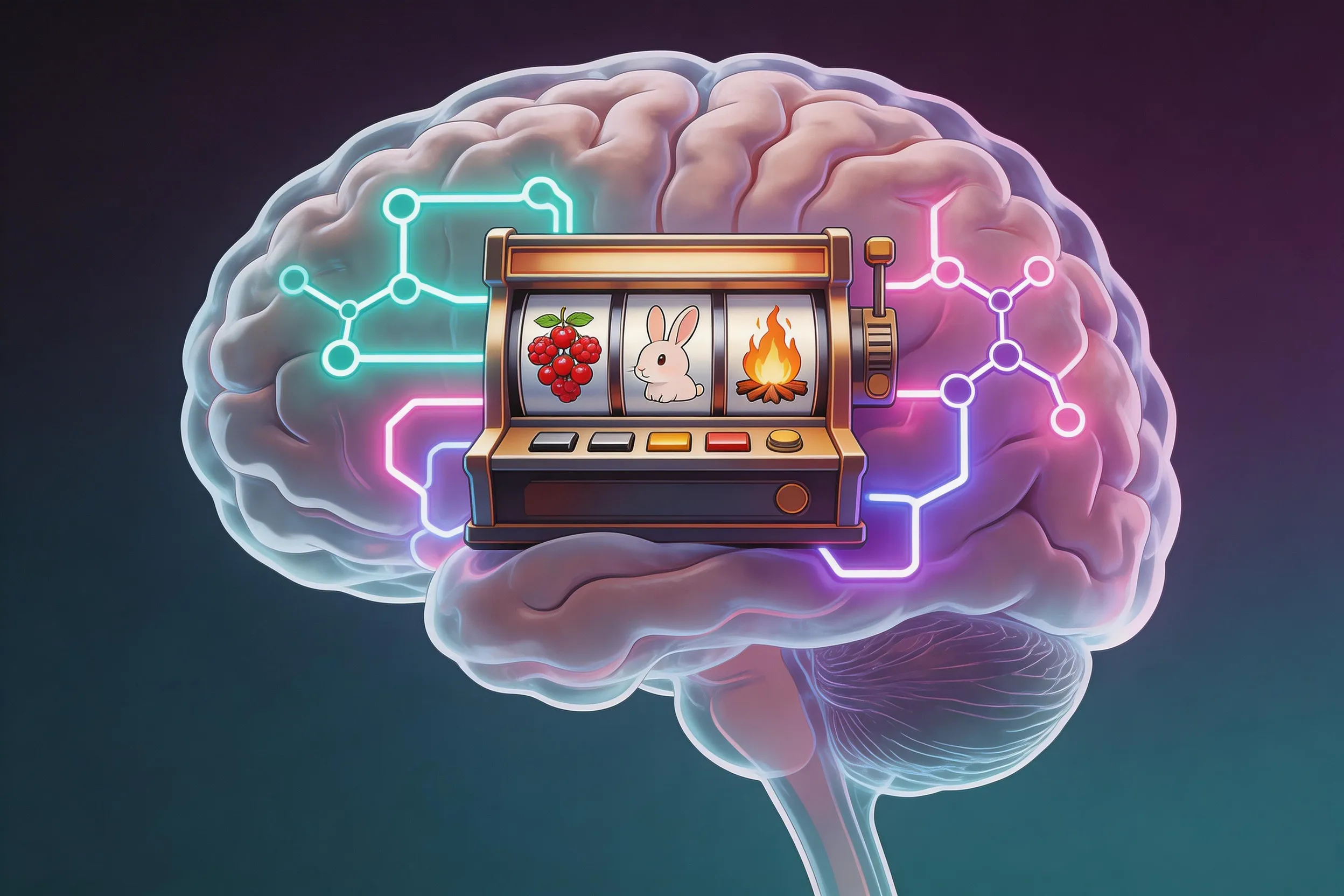
Here's the thing most people get wrong about dopamine: it's not the "pleasure chemical." It's the wanting chemical.
Dopamine doesn't fire when you eat the berry. It fires when you think there might be a berry. Neuroscientist Wolfram Schultz discovered this in a landmark experiment: when monkeys learned that a light meant juice was coming, dopamine spiked at the light—not the juice. The anticipation was the high.
This is not a bug. On the African savanna, your ancestors survived by foraging. Not every bush had fruit. Not every hunt was successful. If your brain only rewarded guaranteed outcomes, you'd sit in your cave and starve. So evolution built a system that rewards searching—especially when the reward is unpredictable.
Psychologists call this Variable Ratio Reinforcement. You know it by its modern name: the slot machine. Pull the lever, sometimes you win, mostly you don't—but the uncertainty is what keeps your hand on the lever. Your dopamine system was the original slot machine, millions of years before Las Vegas existed.
The Hijack: How Apps Reverse-Engineered Your Ancestors
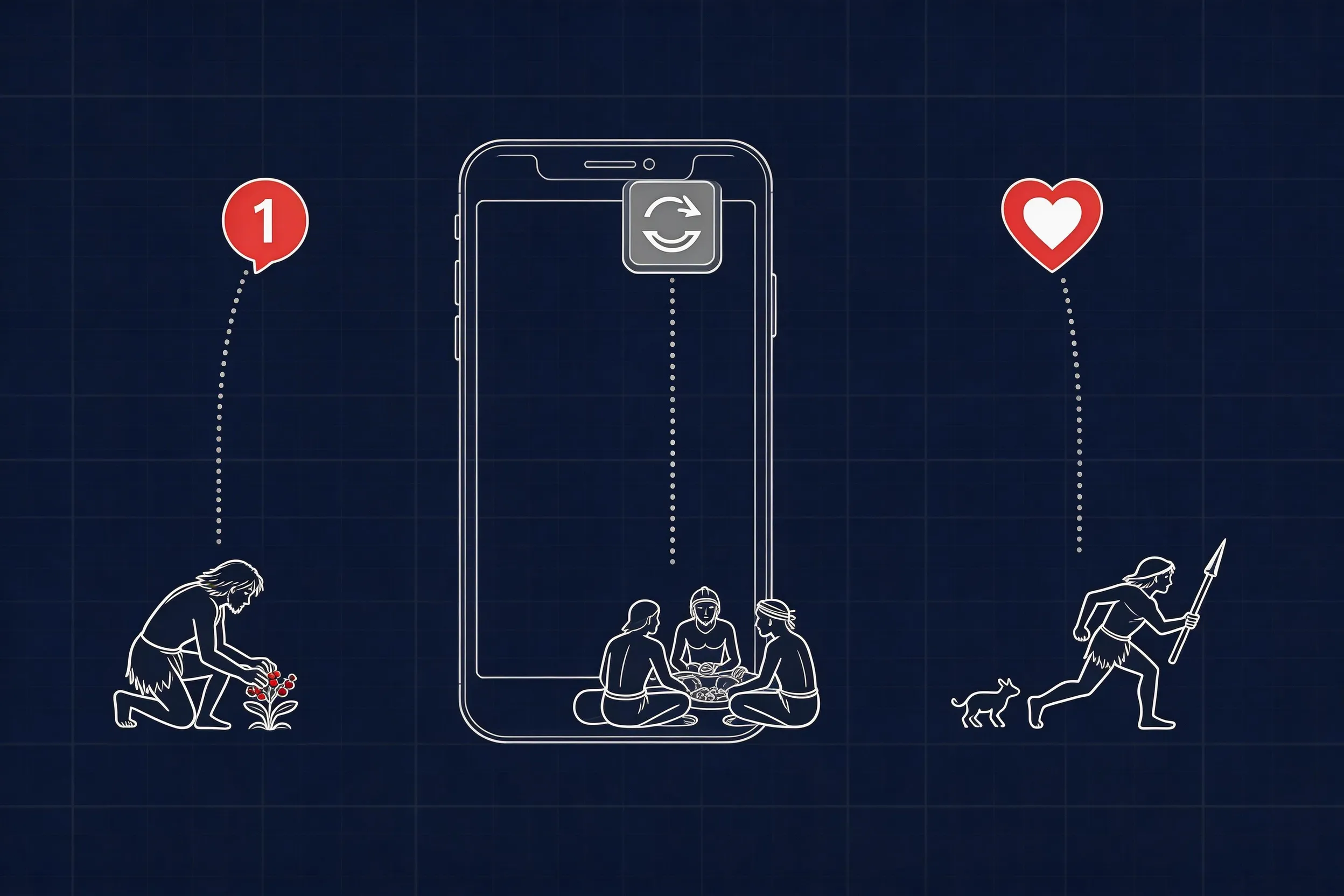
Silicon Valley didn't invent addiction. It just studied your brain and built a better trap. Here's how three common design features exploit three ancient survival instincts:
Infinite Scroll → The Foraging Instinct
Your ancestors never found a bush with a sign that said "No more berries past this point." Nature doesn't have a last page. So your brain never evolved an internal signal for "enough searching"—it relies on environmental cues to stop.
Infinite scroll removes those cues. No bottom of the page. No endpoint. Your foraging brain sees an endless field and keeps going, convinced the next swipe might reveal something worth finding. It usually doesn't. But maybe.
Notification Badges → The Social Surveillance Instinct
That little red dot is not a friendly reminder. It's a fire alarm.
In a small tribal group of 50-150 people, missing a social signal could be fatal. If the group decided something about you while you were away—if alliances shifted, if gossip spread—you needed to know immediately. Being socially excluded from the tribe didn't hurt your feelings; it killed you.
The red notification badge hijacks this ancient panic button. It doesn't say "someone liked your photo." Your limbic system reads it as: something happened in the tribe while you weren't looking. Check now or risk being left out.
Unpredictable Likes → Variable Ratio Reinforcement (Again)
You post a photo. Will it get 3 likes or 300? You don't know. And that uncertainty is exactly why you keep checking.
If every post got exactly 50 likes, you'd stop checking after the first time. The dopamine system only fires hard when outcomes are unpredictable. Social media engineers know this. The feed is algorithmically shuffled, likes trickle in at uneven intervals, and comment notifications are staggered—all to keep the "slot machine" paying out at random.
Fighting Back with Evolution, Not Against It
You can't uninstall your dopamine system. And "just use your phone less" is as useful as telling a hungry person to "just stop being hungry." Instead, work with your ancient wiring.
1. Batch Your Notifications
Check your phone at set times—say, three times a day. Why this works: you're converting variable rewards into fixed rewards. When you know exactly when the "juice" is coming, dopamine spikes flatten. The compulsion fades. It's boring, and that's the point.
2. Move Your Body for 20 Minutes
A walk, a run, a stretch—anything physical. Your ancestors' reward circuit completed in a cycle: search → find → consume → rest. Scrolling traps you in an endless search phase with no "find." Physical movement triggers the "successful hunt" completion signal your brain is starving for.
3. Replace, Don't Remove
Your brain needs novelty. Denying it entirely is like holding your breath—you'll eventually gasp. Instead, swap digital variable rewards for physical ones: walk a new route, try a recipe you've never made, have an unplanned conversation with a stranger. Same dopamine, different—and healthier—source.
4. Go Grayscale
Color vision evolved partly to spot ripe fruit against green leaves. Bright reds and oranges scream "reward here!" to your visual cortex. App designers know this—hence the red badges, the vibrant thumbnails, the saturated feeds. Switch your phone to grayscale mode, and your brain quietly downgrades it from "fruit tree" to "dead branch."
The Oldest Brain in the Newest World
Your brain is not broken. It is an exquisitely tuned survival machine—built for a world of scarcity, uncertainty, and small tribes. The tragedy is that it now operates in a world of infinite content, engineered unpredictability, and global social networks.
Knowing this won't magically cure your screen time. But it does something more important: it shifts the question from "What's wrong with me?" to "What am I actually up against?"
And that is where you get your choice back.