Binary Options: The Casino That Calls Itself an Investment
It looks like trading. It feels like analysis. But your brain is running the same software it runs at a slot machine.
A man stares at a candlestick chart. He draws a trendline. He checks the RSI indicator. He clicks "UP"—confident, analytical, in control. Sixty seconds later, he's lost $200.
He doesn't walk away. He tells himself: "My analysis was right, but the market moved against me. I'll adjust my strategy."
Except there is no strategy. There is no analysis. What just happened is psychologically identical to pulling a slot machine lever. The only difference? The slot machine doesn't pretend to be a career.
Why Your Brain Thinks It's Investing
There is no objective line between "gambling" and "investing." The distinction lives in your head—specifically, in whether your brain activates what psychologists call the Illusion of Control.
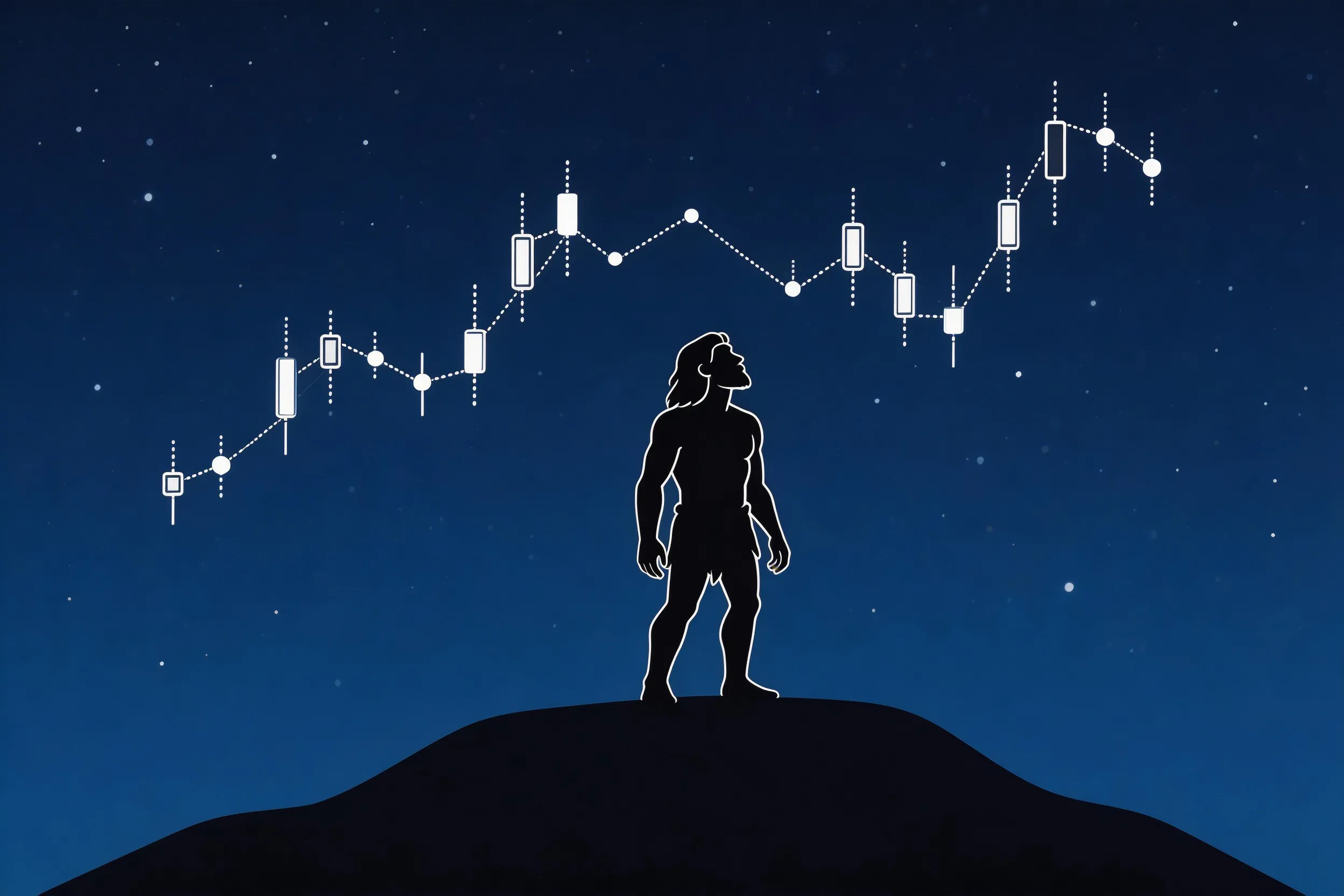
This illusion has deep evolutionary roots. Your ancestors survived in a dangerous, unpredictable world. A rustle in the grass could be wind or a predator. The brains that survived were the ones that found patterns everywhere—even where none existed. Seeing a tiger that isn't there costs you a moment of fear. Missing one that is there costs you your life.
So evolution built a brain that is a compulsive pattern detector. It connects dots, draws lines, and constructs narratives from noise. This served us well on the savanna. It does not serve us well on a trading platform.
Binary options hand your pattern-seeking brain exactly what it craves: charts, candles, indicators, moving averages. Your neocortex lights up. It says: "This is data. I can analyze this. I can find the pattern." But statistically, short-term price movements are indistinguishable from random noise. You're drawing constellations in static.
The Design: How Binary Options Hijack Three Instincts
Binary options platforms aren't just financial products. They are behavioral engineering, refined through the same principles that make slot machines, loot boxes, and social media feeds compulsive. Three design features exploit three ancient weaknesses:
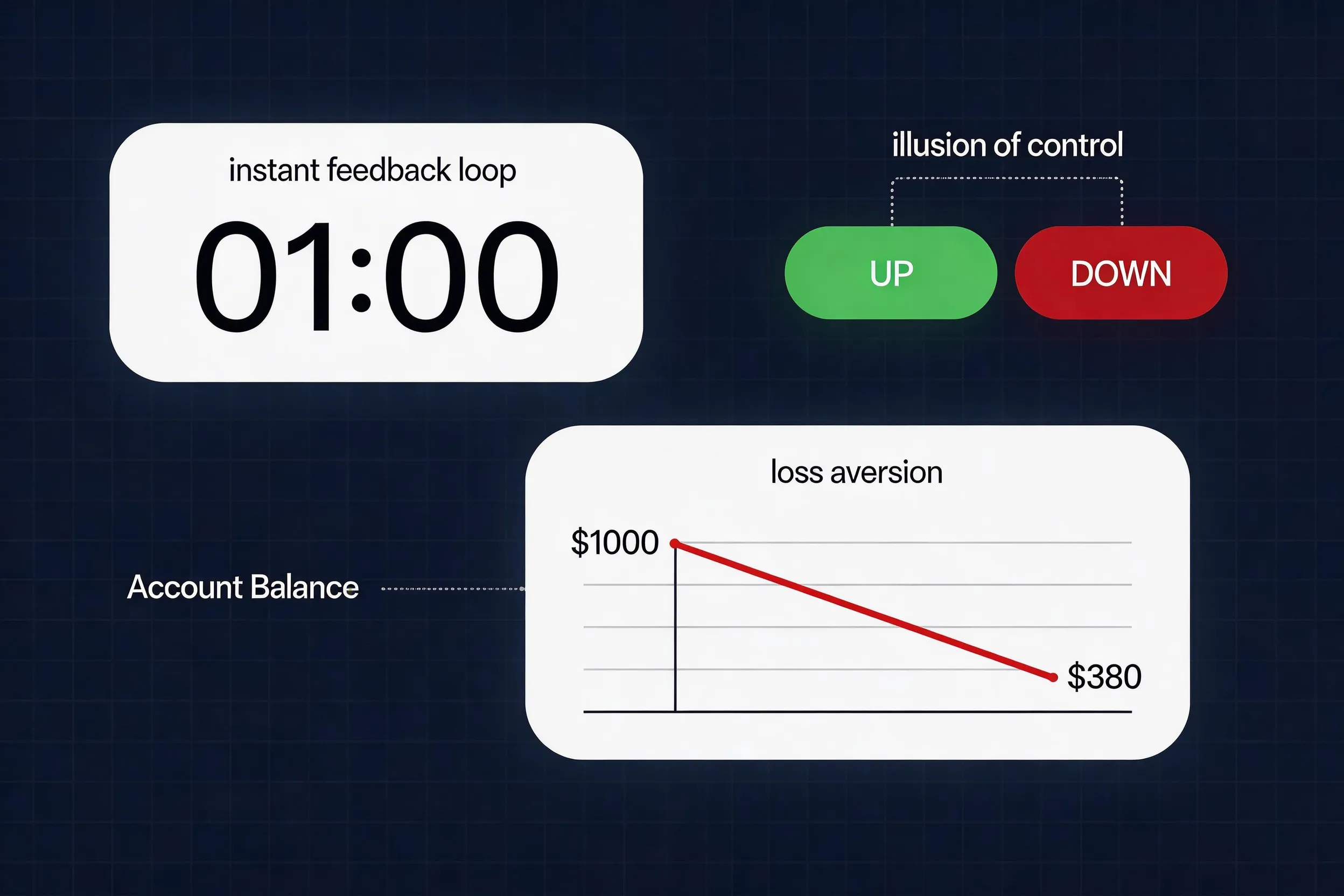
60-Second Settlement → Instant Feedback Addiction
Your dopamine system needs a fast loop: action → outcome → repeat. Evolutionary reason: when foraging, the faster you know whether a bush has berries, the faster you can move to the next one. Speed of feedback is the critical variable in habit formation.
Traditional investing is slow. You buy a stock and wait months. Boring. No dopamine spike. Binary options compress the cycle to 60 seconds. Action, outcome, repeat. Action, outcome, repeat. The neurochemical rhythm is identical to a scratch card—except you can do it 500 times a day.
Up/Down Binary → The Illusion of Decision
A coin flip doesn't feel like a decision. But "Will the EUR/USD go up or down in the next 60 seconds?"—somehow, that does. Why?
Because there are only two options, your brain categorizes this as a choice, not a bet. Choices imply agency. Agency implies skill. This is the illusion of control at its most elegant: the fewer the options, the more your brain believes it is deciding rather than guessing.
And when you win three in a row—as you statistically will, sometimes—recency bias kicks in. Your brain whispers: "I'm reading the market." No. The market is random. You are experiencing a normal distribution.
"One More Trade" → Loss Aversion and Sunk Cost
You've lost $500 today. You know you should stop. But stopping means accepting the loss as real. Evolution made this extraordinarily painful—losing resources carried twice the psychological weight of gaining them, because on the savanna, losing your food cache could be fatal.
So your brain offers a deal: "One more trade and you could win it back. Then the loss never happened." This is the sunk cost fallacy fused with loss aversion—two of the most powerful cognitive biases humans have, firing simultaneously, both screaming at you to keep going.
The Suit That Makes It Invisible
Here's what makes binary options more psychologically dangerous than a casino: you don't know you're gambling.
A casino has neon lights, chips, and cocktails. The environment signals: this is entertainment, not work. You might lose yourself, but at least you entered the building with eyes open.
Binary options wear a suit. The vocabulary is financial: "assets," "positions," "technical analysis," "portfolio management." The interface looks like Bloomberg, not Betfair. There are "educational webinars" and "trading academies."
This packaging activates self-concept protection—a psychological defense where your brain rejects information that threatens your identity. Admitting "I am gambling" would contradict "I am a rational person making informed financial decisions." So your brain simply refuses to make that connection. You lose money and think "I need better analysis," not "I need to stop gambling."
This is the trap's final layer. At a casino, losing feels like bad luck. With binary options, losing feels like a skills gap—which means the answer is always more, not less.
The Tiger in the Grass
None of this makes you stupid. It makes you human. Your brain is running software that kept your ancestors alive for 200,000 years. The problem is that the same software—pattern detection, fast-feedback seeking, loss aversion—is now being weaponized by platforms engineered to exploit it.
Knowing this won't make you immune. But it changes one thing. The next time you stare at a chart and feel certain you've found the pattern, you might hear a quieter voice asking:
Is that insight—or is my brain seeing a tiger in the grass that isn't there?